

Mid Range Performance - The Railgun's Fatal Flaw
Unlike conventional naval guns whose rounds deliver both kinetic and explosive energy, the railgun's need for high impact velocity means it cannot deliver good resuls at mid over the horizon ranges.

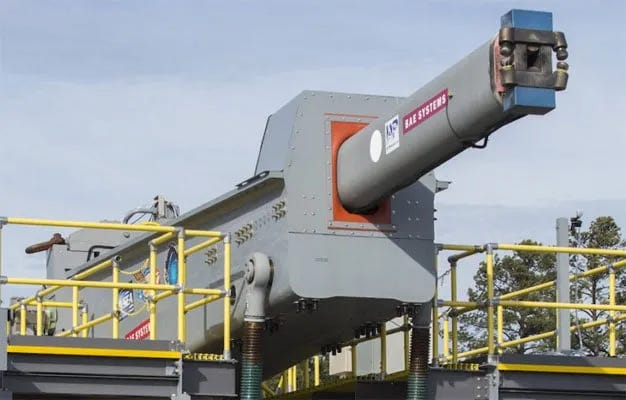
Railgun Mid-Range Weaknesses: A Concise Summary
The railgun’s extreme muzzle velocity (~2,500 m/s, Mach 7+) creates two fundamental, interconnected mid-range problems when when striking at target roughly 5–50 nautical miles (nm) downranges that render it impractical for most naval fire support missions without unacceptable compromises.
The railgun’s super fast flat velociy creates a flat trajectories that does not allow the railgun to engage some over-the-horizon targets.
High speed means very short time-of-flight and minimal gravitational drop. For targets just beyond the horizon (e.g., 5–10 nm), the natural gravitationally induced arc is too shallow to clear Earth’s curvature and dip down onto low-lying structures (hull, deck). Hence some targets cannot be effectively engaged as the railgun round will fly harmlessly above it.Low-angle railgun rounds aimed at mid-range over-the-horizon targets that can be struck by full power railgun shots will suffer catastrophic drag losses.
Keeping the trajectory low to maintain reasonable Time of Flight (TOF) forces the lightweight (~10 kg, ~30–40 mm diameter) projectile to remain in dense lower atmosphere. Hypersonic drag is proporional to the square of velocity (v²). This, combined with a railgun rounds effective drag coefficient (Cd) of ~0.15–0.30+ (including plasma sheath and ablation) bleeds 70–90% of the railgun round’s 32 MJ muzzle energy, leaving terminal impact energy of only 3–10 MJ—much less destructive than a conventional 5-inch explosive shell.
The only ballistic “fix” is near-vertical launch angles (typically over 85°+) to rapidly loft the projectile into near-vacuum conditions (above ~100 km altitude, where drag is negligible).
Apogee: 150–315 km depending on exact angle (approaching ~318 km max at straight-up).
Time-of-flight: Stabilizes at ~7.5–8.5 minutes even for mid-range targets (time of flight plateaus as angle nears 90°).
Energy retention: Improves to 50–70% due to coasting in vacuum.
Required guidance: Unguided hits are impossible against anything but large perfectly static targets; mobile targets (ships) move miles in 8 minutes. Active terminal guidance is mandatory—but the Navy never solved electronics hardening for 40,000+ g launch acceleration + electromagnetic interference.
Net result: For practical mid-range engagements, the railgun is forced into slow, predictable, space-lofting shots that turn a supposed rapid-fire gun into an expensive, guidance-dependent quasi-missile with minutes-long delays—completely unsuitable for dynamic naval combat or responsive fire support.
Conventional guns, with lower velocity (Mach 2–3) and heavier explosive shells, produce natural, responsive arcs at modest elevations (10–30°), hitting the same targets in seconds with superior terminal effects and volume of fire.
This mid-range ballistic trap—more than any single engineering hurdle like barrel wear—is the deepest reason railguns never made sense as a general-purpose naval weapon replacement. The physics simply doesn’t allow the “best of both worlds” the hype promised.
Of course there are no railguns that can fire more than a few shots at full power, before the rails/barrel needs replacing.
Note: When power is reduced below full power railguns can fire hundreds of shots before needing to replace the barrel. A practical naval gun needs to be able to fire thousands of rounds before replacement.