

Why Warplane Sortie Generation Rate Is the One Key Performance Parameter to Rule Them All!
No matter how "advanced," a plane sitting in a hanger or on the tarmac or undergoing depot maintenance is just a sitting duck.

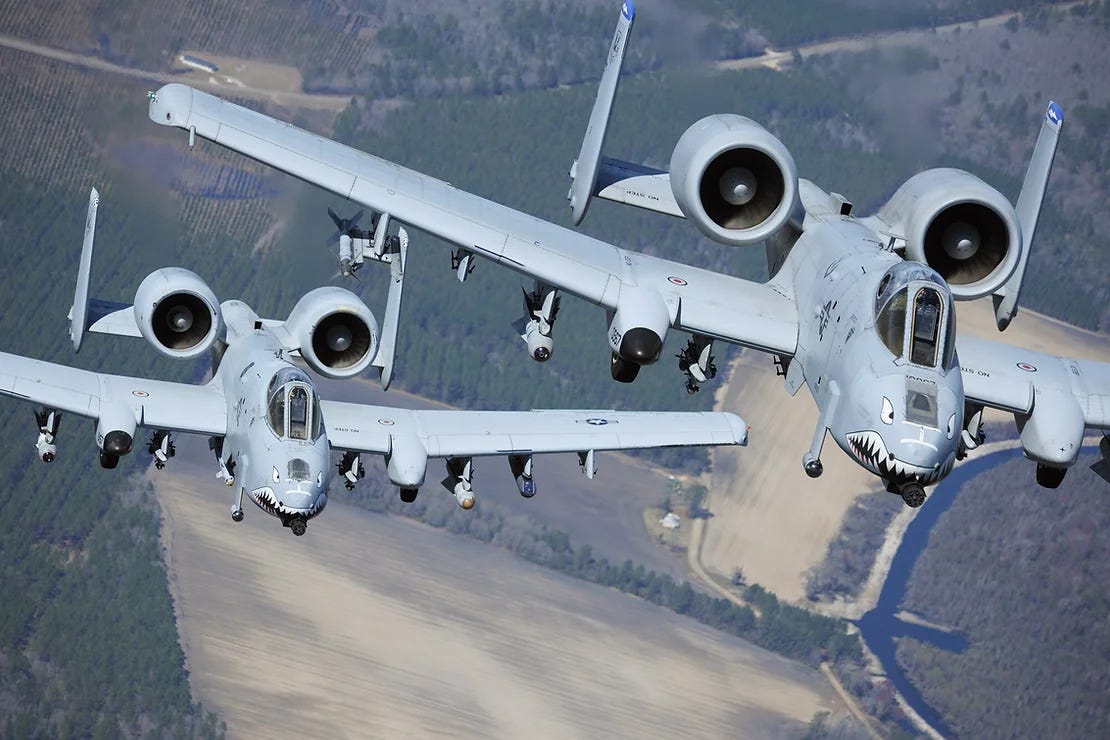
While the A-10's toughness is legendary, and its modernized avionics make it second to none when it comes ground attack sophistication and effectiveness, it is its very high sustained sortie generation rates that give it an unmatched, ability to destroy and intimidate the enemy. The F-16 has also been able to maintain high SGRs
"It isn't how many airplanes you have. It's how many you can put in the air, what they can do, and how long you can keep them flying."—Robert S. Dudney, former senior editor, Air Force Magazine.
Warplane enthusiasts love to debate and discuss such statistics as top speed, turning rate, payload, angle of attack, radar cross-section, roll rate, etc. Much less discussed is what's arguably the single most important characteristic for a warplane: its sortie generation rate (SGR).
In military aviation, a sortie is the mission of an individual aircraft, starting when the aircraft takes off and finishing when it lands. For example, one mission involving six aircraft would tally six sorties. More specifically, if an F-16 takes off for the purpose of attacking enemy ground targets, does so, and then returns to base, then it has completed a sortie. Even if the F-16 ended up not attacking its targets, it would still be a sortie.
The SGR is the number of sorties that can be consistently maintained over a given period of time. A typical time period would be a 24-hour period. When a plane can maintain a certain SGR over a longer period of time, let's say a week or month, that will often be referred to as the sustained SGR.
Higher SGRs Equal More Combat Power
In short, a plane with a higher SGR will be able to spend more time in the air than a plane that has a comparable loiter time and or operational radius but can't fly as often. Assuming all other capabilities are roughly comparable, the plane with a significantly higher SGR will provide more overall combat power as it's actually in the air, while the other plane is on the tarmac or in the hangar.
It's often the case that the latest and greatest fighters may have superior capabilities on paper, but because they contain advanced/bleeding edge technology that may or may not provide real-world combat power, they require far more maintenance than do “less-advanced,” more reliable aircraft. The end result is that the most complex plane will often have a much lower SGR than that of a less-complex, more reliable aircraft, and consequently generate less real-world combat power. And, of course, more reliable aircraft generally cost less to fly per hour.
High SGR Fighters Enable More Skilled Pilots
The higher reliability and lower cost per flying hour of a high SGR plane enables
